Anyone who has ordered something in B2B knows the reality: you know what you need and still click your way through seven steps. Set three filters. Open four categories. Pick a variant that turns out not to be available. Call the salesperson because the list price is not your price. Send the order by email after all, because that is faster.
Anyone who has ever distributed a task in the back office knows the other reality: three programs open, one for accounting, one for shipping, one for correspondence. Marion reads the inbox, switches to the ERP, switches to the tax archive, writes an email. Four programs, one case.
We asked ourselves whether it really has to be that way.
One input line in both worlds
The HeiniBar is one line at the top edge. Nothing more. You type or speak what you want, and Heini does it. The bar lives in two worlds: in the shop where your repeat customers buy, and in the suite where Marion and Thomas work in the back office. It is the same bar, the same style, the same voice. Only the tasks are different.
In the shop — when the buyer asks instead of searches
A repeat customer types: “I need two hundred screws, M8, galvanised.” Heini shows three matching products, the most recent orders on top. The customer picks a variant. Heini hides what cannot be combined right away — the disappointment at the end of the checkout disappears.
“When can you deliver?” the customer asks. “Aachen plant, one hundred and forty-two in stock, with you Wednesday two o’clock.” One sentence instead of three menus.
“Last month you ordered fifty cartridges — again?” One click. Done. The repeat order that a regular customer makes every three weeks no longer takes three minutes — it takes three seconds.
When the customer asks for five thousand pieces, Heini routes the inquiry to sales and order processing. The customer gets the quote as soon as it has been reviewed. They do not need to call anyone, search for anyone, write any email.
Heini knows the customer’s framework agreement and shows their own price, not the list price. They can ask at any time: “What does this position cost for me?” and get the right answer.
When the customer’s own buyer asks for the digital product passport — the ESPR required fields, ready for their auditors — the buyer presses a button and has the document.
In the back office — when the bar replaces the program switch
Marion presses Cmd+K. Three letters. She is where she wants to be. Faster than any mouse.
“Tell the tax advisor that April’s bookkeeping is finished.” Heini drafts. Marion approves. What used to be a switch between mail program and tone register is now one sentence.
When the answer gets long, when an explanation has many lines, Heini can read it aloud. Marion has her hands full, or she walks through the warehouse — she hears what she would otherwise have to read.
With the tax advisor, Marion is formal. With the warehouse, short and direct. Heini adapts. House style does not come from a drawer, it comes from the people working in the house — Heini learns it instead of bringing his own.
Heini has prepared something overnight — an invoice line item, an order reply, a shipping job. Marion sees the matter in the bar, with the raw data alongside. She clicks “approve” or “stop”. She does not switch to a different program. She sees what she is approving.
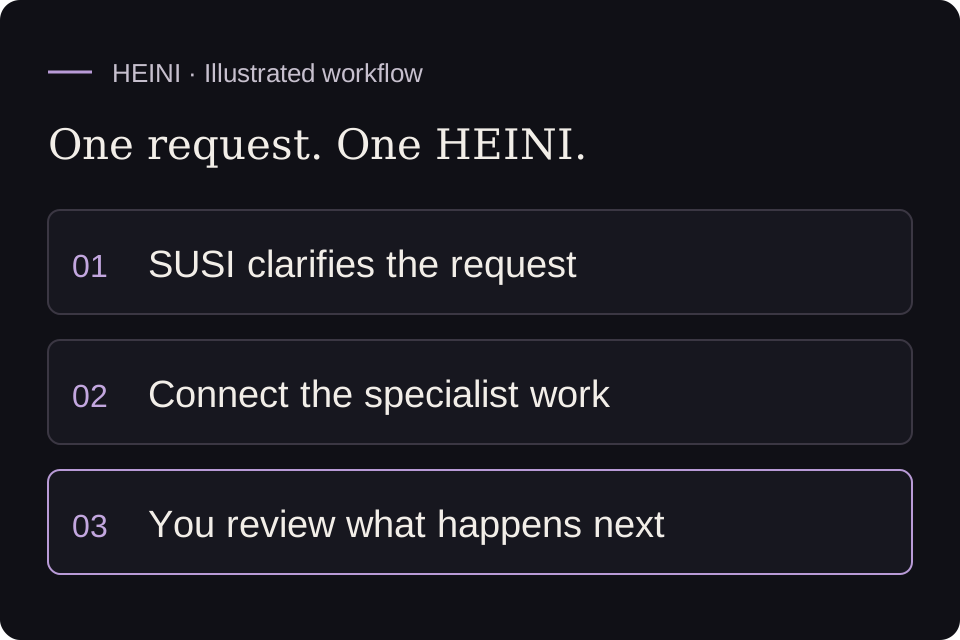
When the case is larger, Heini shows step by step which area contributed what. “Bookkeeping has reviewed. Logistics has shipped. Tax filing has archived.” Plain language. Marion sees the trail. Thomas sees the trail. The auditor in two years sees the trail.
And when Heini is not sure, he says so. “I am not certain — would you rather do this yourself?” Heini does not push through.
28 colleagues, not one black box
Behind the bar wait 28 specialist colleagues. Bookkeeping, logistics, sales, order processing, tax filing, compliance — each has their responsibility, each can do what fits their role, and nothing beyond. Whoever maintains bookkeeping does not reach the warehouse. Whoever does shipping does not reach the tax archive. This is not a limitation we built in later — it is the architecture.
More autonomy only happens if you grant it. Heini is brought up to speed like a new colleague. When he becomes uncertain, he steps back. When you trust him with more, you enable it. You remain the person who decides.
In the shop and in the back office
Other vendors give you either a plugin for the shop or an application for the back office. The HeiniBar lives in both worlds. The same style. The same voice. The same reliability. Anyone used to Heini in the back office finds their way in the shop right away — and vice versa.
For repeat B2B customers who keep ordering similar things, that is a difference. Seven clicks become one click. Three programs become one line. “I will call back later” becomes “done”.
What you save
The call to sales because the list price is not the contract price. The switch between three programs for one case. The disappointment at the end of the checkout when the variant turns out not to be available. The attempt to remember what the repeat customer ordered last quarter.
And the seconds that every click path costs, every day, a hundred times. They add up to hours. They add up to days.