Why the next layer of the enterprise stack does not need more intelligence — it needs provability.
Over the last twelve months, a quiet consensus has formed in board rooms: autonomous software will become part of value creation. Copilots, reasoning engines, digital colleagues — the market terms vary, the promise is similar everywhere: close tickets, place orders, review contracts, move liquidity.
A question rarely spoken in pitches: Who is liable when an autonomous system decides incorrectly?
Not in the abstract. Concretely: when a digital colleague in procurement releases a batch that gets recalled later — who proves on which data the decision rested? When a compliance function waves through a transaction later flagged as suspicious — who reconstructs the decision chain? When two autonomous systems negotiate with each other — which log file counts in dispute?
The answer typically given today is: “we log everything.” That is not an answer. It is a request to trust a record that the vendor writes, stores and analyses on their own. In dispute, that is roughly as load-bearing as a diary kept by the defendant.
Three layers emerging now
Looking at the stack of the next ten years soberly, three layers stand out:
Data Layer. Where data moves reliably between systems, including between on-chain and off-chain worlds. A category has emerged here over the last few years — oracles, cross-chain protocols, the corresponding compliance logic. In May 2026 SAP consolidated this layer with the acquisitions of Dremio (Apache Iceberg-native lakehouse) and Reltio (master data management).
Application Layer. Where autonomous systems take decisions. The big platforms are building here — and this layer gets most market attention today. SAP Joule, Microsoft Copilot, Google Gemini Enterprise, Salesforce Einstein — all of them target this layer.
Proof Layer. Where decisions become cryptographically verifiable. Hash chains, sidecar attestations, proof points per action. This layer is structurally underbuilt today. That is exactly where HEINI works.
Why logging is not enough
Logging is an internal convenience. It answers: “what did we record?” It does not answer: “what can I prove in court or before a regulator?”
Provability has three properties classical logging does not deliver:
- Tamper resistance. A hash chain only has value if every link seals the previous one. A retroactively edited log file is not one.
- External verifiability. The party that checks must not be the vendor itself. Otherwise the mark-to-self problem we know from the financial crisis emerges — a valuation only the valuer can reconstruct is worthless in conflict.
- Selective disclosure. A regulator does not want to see the entire enterprise log file. They want to prove that this one decision at this point in time was based on this data. Data protection requirements and trade secrets allow nothing else.
Three properties that do not exist in classical observability — because those tools were never built for regulatory proof, but for performance monitoring.
Update: application and evidence
The original April deadline statement was corrected on 21 September 2026. The AI Act applies in stages; relevant duties depend on the use and risk classification. Article 12 does not require a general cryptographic notary. The architecture described here is a technical position, not a statutory requirement or a compliance guarantee. Current EU timeline · Article 12.
What HEINI does
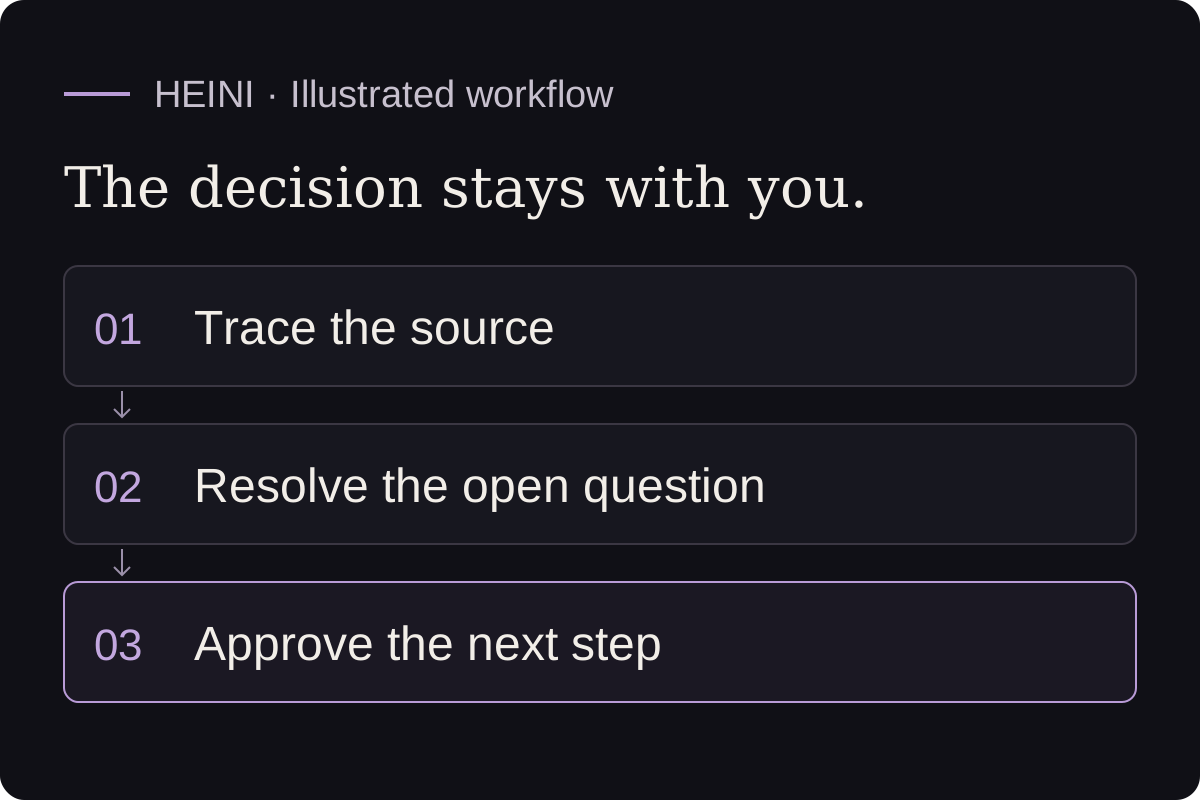
HEINI is not another platform for autonomous software. We are not building a competitor to the large vendors rolling out digital colleagues today. We build the layer underneath: the sidecar attestation that seals every action with a hash, that produces proof points, that can be selectively disclosed, that works in regulated single-tenant contexts — exactly where banks, law firms and critical industries have to operate.
The architecture works on a clear approval principle: every action by a digital colleague passes a pre-flight permission check against a stored competence profile before it is executed. A three-stage deletion cascade under GDPR Article 17 demonstrates forgetting not by claimed deletion, but by an irrefutable difference record. An external attestation anchor records the order of decisions, admissible under German law.
What this is about
The category “Proof Layer” will be claimed in the coming months — either with a precise, legally load-bearing term that gives the market a clear standard, or with a marketing label that hides the actual gap.
We are betting on the first option. If you want to talk to us — as a regulated industry, as a law firm with compliance mandates, or as a platform looking to make its application layer audit-ready — you can reach us through the channels on this site.
HEINI Operations UG. Questions and feedback are explicitly welcome.