Correction, 4 September 2026: Clarified battery categories and the 2 kWh threshold; corrected the claimed blanket textile/DPP and eFTI deadlines in 2027 and the promise of automatic legal updates. The original publication date and URL are retained. Product workflows described here require evidence for the specific implementation.
What this is about
Article 77 of the EU Batteries Regulation requires a battery passport from 18 February 2027 for LMT batteries, industrial batteries with a capacity greater than 2 kWh and electric vehicle batteries placed on the market or put into service. The capacity threshold applies to industrial batteries. For other product groups, the relevant legislation determines scope and application dates; there is no blanket 2027 DPP deadline.
Most mid-sized manufacturers we speak to know this. They also know they are affected. What they do not know is: how does the data get to where it needs to go without the company standing still for three quarters.
That is exactly what this piece is about.
The pain points nobody likes to talk about
First: the data is in the house, but not together.
The material proof sits with procurement. Energy consumption sits in production. Repair history sits with service. The recycling concept — if it even exists yet — sits with an external consultant. The CO₂ balance gets calculated once a year for the annual report, not per batch, not per serial number.
The applicable legislation determines whether information is required at model, batch or individual-product level. First establish the requirements and the sources needed to support them.
Second: the ESPR mandatory fields are a moving target.
Requirements differ by product group. The current work plan envisages adoption of the delegated act for textile apparel in 2027. Adoption is not the same as a confirmed application date. A machine used to manufacture textiles is also not itself textile apparel.
Third: most DPP vendors sell an island.
They collect the DPP data and write it into the register. What they do not do: they do not talk to the bookkeeping that posts incoming goods. They do not talk to the logistics that writes the eFTI freight documents. They do not talk to the sales people who took the order.
The result is absurd: the DPP solution asks the employee again for data the company has long had — just in other systems. The mid-sized manufacturer pays for a tool whose main job is to find data that already belongs to it.
Fourth: the audit question.
When a market surveillance authority shows up in 2028 and asks for the product passport for batch B-2027-118, having the data is not enough. It must be provable that this data was present at the time the product entered the market — not tidied up retroactively. Plain database entries without tamper resistance fail in any serious audit.
Fifth: the update obligation.
The DPP is not “set up once, done”. Repairs, component swaps, ownership changes, recycling certificates — the passport lives with the product, often fifteen, twenty years. Anyone maintaining that by hand builds up an original sin that catches them by year three.
What HEINI does differently
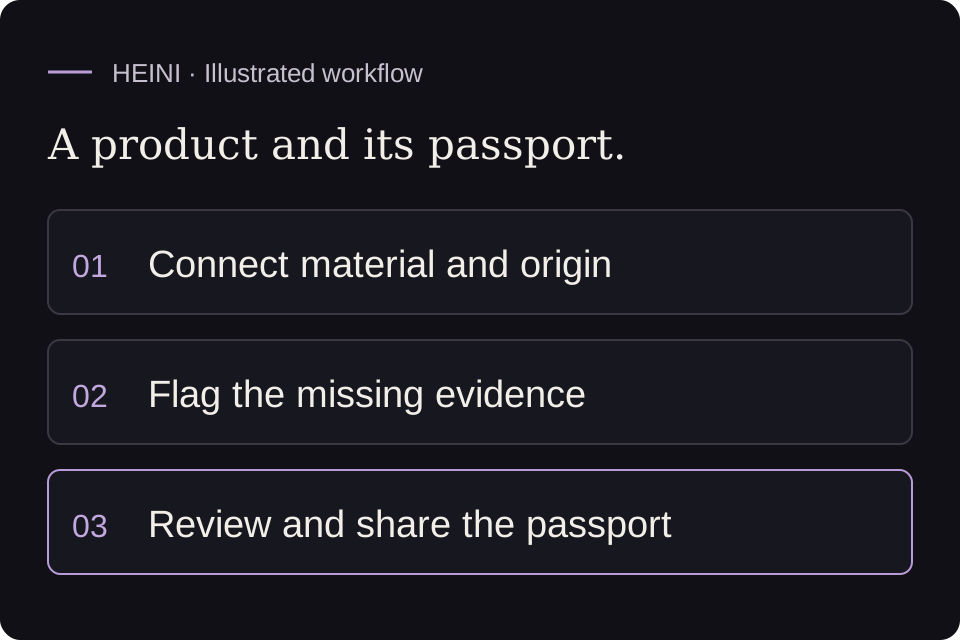
HEINI is not a DPP tool that you stand next to your ERP, next to your bookkeeping, next to your logistics. HEINI is the layer that connects all three — and the DPP is one of many disciplines running on this layer.
Concretely that means five things.
One: the data comes from the sources where it arises anyway.
When procurement uploads a material proof to the supplier portal, it lands in the DPP. When production closes a batch, the energy consumption lands in the DPP. When service documents a repair, it lands in the DPP. Nobody fills anything out twice. Susi, the digital receptionist, asks back directly in the Slack channel when in doubt — in normal language, not in forms.
Two: requirements and data are reviewed together.
New legislation can require additional information, sources and checks. HEINI can support preparation. Applicable fields and the availability of a specific integration must be verified before use. This does not promise automatic adaptation to every future legal change.
Three: the audit proof is built in, not bought separately.
Every DPP entry receives a tamper-resistant time stamp at the moment it is created — a cryptographic anchor that cannot be deleted or altered after the fact. When someone asks in 2028 whether batch B-2027-118 was really produced on 14 November 2027 with this recyclate share, the answer is technical, not a matter of trust. That is exactly what market surveillance and auditors will expect from DPP data in the coming years.
Four: the passport lives with the product.
Repairs, component swaps, ownership changes — all run through the same layer. HEINI appends the new records to the existing passport without overwriting the old data. If a customer wants to know fifteen years after sale who swapped the battery pack in 2031 — the answer is in the passport.
Five: circular economy is built in, not extra.
The DPP is the EU’s answer to the recycling problem. But the truly interesting use cases only emerge once the data can flow: repair acceptances checked in seconds instead of hours. Recyclate shares that procurement can see live for the next order. Warranty extensions that apply automatically because the passport proves the device was correctly maintained. HEINI makes these enrichments automatic — the mid-sized manufacturer does not have to commission any programming.
What this means in money
Anyone buying the DPP as a stand-alone product pays three times: once for the DPP vendor, once for the interface to the ERP, once for the audit-ready archive. From 9 July 2027, authorities must accept information supplied electronically through certified eFTI platforms. This does not create a general obligation for businesses to purchase a digital freight document. When the next industry joins in 2028, a fifth.
Whoever has HEINI pays once — for the layer, not for the discipline. The DPP is in. The freight document is in. The bookkeeping connection is in. The audit trail is in.
This is not a marketing promise, it is architecture. A layer that carries all disciplines costs less than five islands that don’t know each other. More on the layer logic in the trust-stack piece.
What to do now
First check whether your product is subject to a specific obligation and which date applies. For the battery categories named in Article 77, that date is 18 February 2027. Plan data sources, responsibilities and checks around your existing records; no universal project duration follows from the legislation.
See pricing for the four plans (Basis, Finanzen, Betrieb, Enterprise). Anyone who starts now has a settled layer in the house by the DPP go-live — not a project that is just starting.
The DPP will arrive whether one is ready or not. With the right layer behind you it is not a burden. It is an opportunity to finally organise your own data the way it should have been organised all along.
About HEINI HEINI is the digital layer for the German mid-market. Configuration, bill of materials, product passport, manufacturing, delivery — end to end, in an architecture that grows with European law. More on security and enterprise. Operator: HEINI, Münster.
Sources