With Agentic Commerce and the Alliance, Stefan Hamann asks how AI can do reliable work in everyday business. I appreciate this initiative. We share many of these ideas. Book · Alliance chapter
Our focus is the whole business. HEINI combines its own business software, AI colleagues and company knowledge in a shared workspace. Its applications cover customer management, product data, configuration and bills of materials. A suitable existing ERP can remain connected.
An order folder keeps documents, agreements, decisions and next steps together. People and AI colleagues continue work on the same order. Confirmed experience can help with the next relevant task, with its source and access permissions retained. The responsible people decide what applies and approve the necessary steps.
An order needs its full context
A customer wants a made-to-measure PVC strip curtain. The chosen design includes a support rail. Later, a connection dimension changes.
The manufacturing order is our example. In trade and service businesses too, the customer’s request, agreed commitment, work delivered and invoice need to stay connected.
That change may affect the drawing, configuration, parts list, calculation, manufacturing and delivery date. Sales needs a dependable answer. Engineering must review the specification. Purchasing and production need the right revision. The eventual invoice must match the agreed order.
Each person needs more than the latest message: What was ordered? Which drawing applies? What was promised to the customer? What has already been approved? Who decides next?
The component context is real: in the 3D-printing case confirmed by Daniel Heinen, the printed part is the support rail holding the PVC curtain. The change workflow described here is illustrative. PSE is a related company; this is not an independent success reference or a measurement of savings. PVC refers to the curtain, not the unspecified print material of the rail.
Susi opens the right order folder
Imagine an order folder containing the enquiry, quote, drawing, bill of materials, decisions and outcome for one order. The filing cabinet represents company knowledge: guidance and confirmed experience with their sources and appropriate access rights.
Susi is your AI point of contact. She brings the right order folder into the conversation, with customer details, earlier agreements and supporting records. If information is missing, she asks. The next authorised colleague can continue the order instead of reconstructing its history.
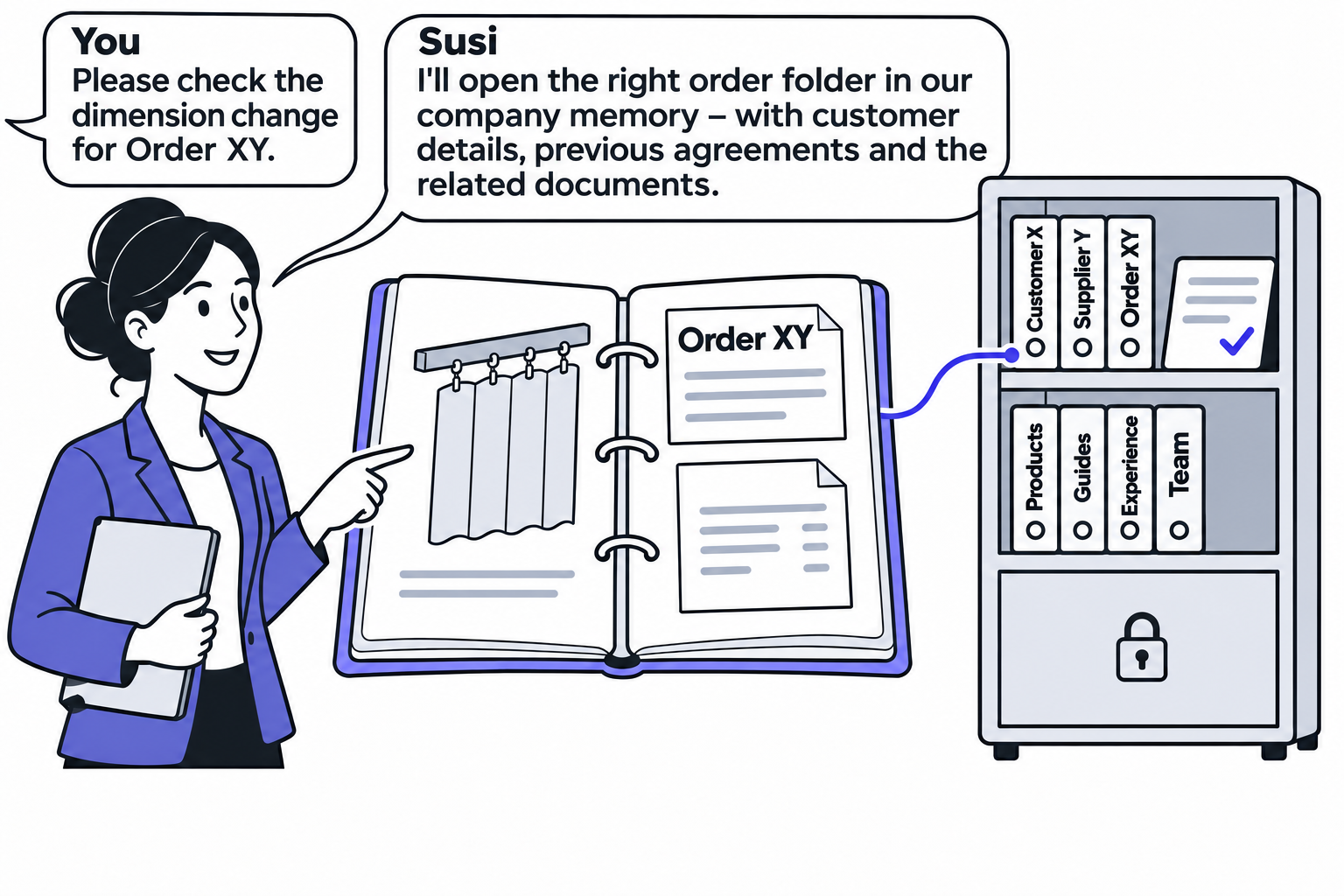
Read the dialogue in the illustration
You: Please check the dimension change for Order XY.
Susi: I'll open the right order folder in our company memory – with customer details, previous agreements and the related documents.
Folder labels: Customer X, Supplier Y, Order XY, Products, Guides, Experience and Team. The lock marks a separate access area.
The AI team lead coordinates the designated tasks and brings their results together. The supervisor reviews them against agreed criteria, requests rework or flags an exception. Technical, commercial and manufacturing approvals remain with the responsible people. These roles explain the collaboration; they do not grant unlimited authority.
Why HEINI brings its own business software
AI needs access to the actual business foundations. Which product combination is valid? Which parts belong to this precise specification sold to the customer? Which price was agreed? A collection of documents alone does not provide authoritative answers.
HEINI therefore includes applications for product information, configuration, multi-level parts lists and customer work. Their technical names are PIM, CIM/CPQ, BOM and CRM. Their purpose is straightforward: people and AI work with the same maintained products, rules and orders.
In the rail example, the drawing and parts-list revision belonging to the accepted order remain identifiable. A later catalogue change does not silently rewrite the order sold. The affected people assess a change and approve the necessary steps.
This also explains our competitive position. Individual capabilities such as chat, search and memory are available in many products. What matters is whether product rules, the order, access rights, authorised action and confirmed result work together, including through a change or interruption. That combination must prove itself in operation.
Learning that stays useful to the business
Experience becomes valuable when it helps with the next suitable order. An employee might add an important inspection question about the rail. A responsible person confirms which cases the lesson applies to, where it came from and when it needs another review.
Susi can draw on that permitted knowledge later. Personal notes, team knowledge and company knowledge retain their different access rights. An earlier exception does not automatically become a general rule. Greater responsibility for an AI task requires separate approval.
Knowledge can then stay useful through handovers, changes of role, retirement and growth. By lasting adoption, I mean precisely this continuity: the business builds on confirmed experience rather than explaining the same context again.
Two routes and a starting point you can test
Route A: HEINI takes on the agreed business-software scope. Matched overlapping applications can be retired after successful acceptance.
Route B: Keep the existing ERP. HEINI adds its own applications, AI work and the shared workplace. Odoo, SAP, Xentral, Sage, Infor or another suitable ERP can provide the foundation. Data ownership, interfaces and responsibilities are agreed for each workflow.
Begin with one useful task. More departments and sites can follow when the value is demonstrated. Separate companies can exchange agreed work through Federation; each keeps its own knowledge and rights. For Enterprise, an own-server setup with a suitable self-hosted AI language model is possible. The tasks processed there and any remaining external services are defined explicitly. Owning the hardware does not remove operating costs or data-protection obligations.
Measure value on the actual order: human handling time, questions, corrections, elapsed time and costs that truly end. Existing AI assistance belongs in the baseline. Freed time is additional capacity; cash savings arise from costs that disappear.
One useful joint test for the Agentic Commerce discussion would therefore be a configured shop order, taken through a change and into manufacturing. Our Shopware integration provides a concrete starting point. This is a possible collaboration idea, not an announcement of an existing partnership.
Which handover costs your business the most context today? Bring that order. We can work through what HEINI handles, where people decide and how to test the benefit.